
New research scrutinizes Trump’s forestry plans

Lance Cheung
Findings confirm: Wildfires 4x more likely to start near roads than in roadless forests
New research in Fire Ecology confirms: wildfires are four times more likely to start near roads than in roadless forests.
The findings are particularly timely in addressing the Trump administration's rationale for repealing the Roadless Area Conservation Rule, the boldest conservation measure in U.S. Forest Service history, which protects 45 million acres of national forest lands from roadbuilding and logging. The administration is expected to release its proposal to repeal the Roadless Area Conservation Rule and a Draft Environmental Impact Statement, which will analyze the impacts of repealing the rule in spring 2026 and open a second public comment opportunity.
Greg Aplet Ph.D., Sr. Forest Scientist at The Wilderness Society and the study’s lead author said:
“There’s no denying the real threat mega-fires pose to our communities and public lands. But opening the door for more roads and logging in our country’s most intact, backcountry forests isn’t a wildfire solution, and it never will be. Despite what the administration says, the Roadless Rule repeal has nothing to do with keeping our communities safe from wildfire. It’s a backdoor agreement that will hand millions of acres of our protected public lands to private industry.
Fires don’t happen unless they start. And this research confirms: more roads mean more human activity that will result in more ignitions, increasing the chances of fires that put communities at risk and stress federal fire crews, already at capacity. The Trump administration should pay attention to this research and the decades of research that’s come before it and base its policy reforms on sound science that tells us keeping ecosystems intact and public lands protected ensures healthy, resilient landscapes now and for future generations.”
Since last spring, the Trump administration has claimed that the Roadless Rule is a dangerous burden, and that logging and building more roads in backcountry forests will decrease wildfire damage. But this new research says the opposite.
The research by scientists at The Wilderness Society examined a large, nationwide dataset to determine whether roads on the national forests are associated with higher ignition risk, and they examined patterns of fire size to see whether wilderness and roadless areas are associated with larger fires.
Their results suggest that building roads into roadless areas is likely to result in more fires. These fires will, on average, be smaller than fires farther from roads, but there will be more of them, and some of them will grow to become large fires.
Topline findings:
- From 1992 to 2024, in all 8 contiguous-US Forest Service regions combined, wildfire-ignition density was lowest in designated wilderness areas (1.75 fires/1,000 hectares), followed closely by Inventoried Roadless Areas (1.97 fires/1,000 ha).
- The highest wildfire-ignition density was in lands within 50 meters of roads (7.99 fires/1,000 ha), and the second highest wildfire-ignition density was in other national forest lands outside of the 50-m road buffers but not in wilderness or roadless areas (3.50 fires/1,000 ha).
- The results show that ignition density is much higher near roads than away from them. Across the National Forest System and in every region examined, the density of wildfire ignitions within 50 meters of a road is higher than in wilderness, Inventoried Roadless Areas, or other national forest lands, often by quite a bit.
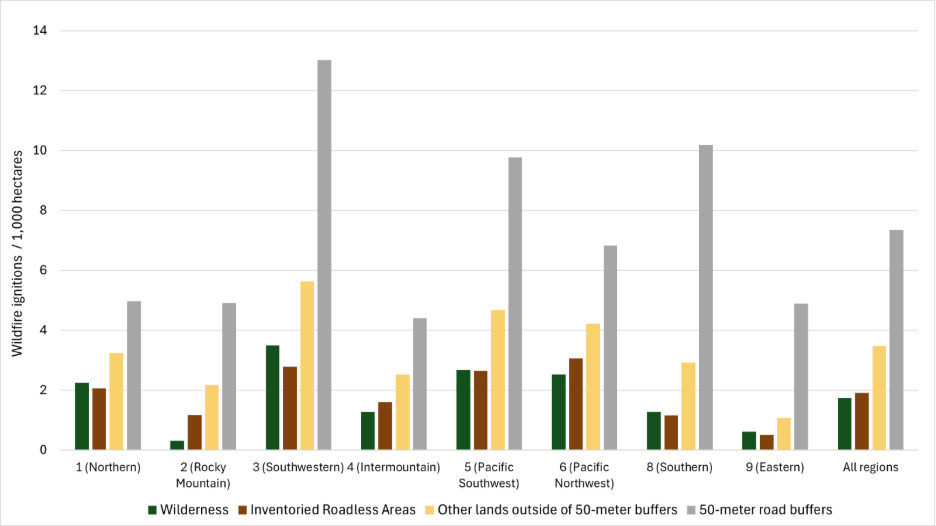
Wildfire-ignition density across U.S. Forest Service regions by wilderness, Inventoried Roadless Areas, other national forest lands outside of 50-meter road buffers, and lands inside 50-meter road buffers.
For more information and to speak to the study’s authors, contact Emily Denny, Communications Manager: edenny@tws.org
