
What’s at stake with the repeal of the BLM Public Lands Rule

Red Cliffs National Conservation Area, Utah
Bob Wick, BLM, Flickr
Rollback to undermine balance and keep development interests in the driver’s seat
On May 11, the Department of the Interior noticed the final rescission of the BLM Public Lands Rule. The administration and some news coverage have framed the reason for the rollback as simple: They claim the rule either places an undue priority on conservation, or even that the rule arbitrarily introduced the idea of conservation being a legitimate “use” of public lands in the first place.
The truth: The BLM Public Lands Rule provided the guidance to finally follow the agency’s nearly 50-year-old congressionally mandated charter, which calls for the long-term management of land for multiple uses to ensure a sustained yield of natural resources. In effect, the rule articulated how the nation’s largest land-steward should go about achieving balanced management—allowing for everything from energy development to livestock grazing to, yes, conservation. The administration’s rollback is intended to upset that balance and keep industrial interests firmly strapped into the driver’s seat.
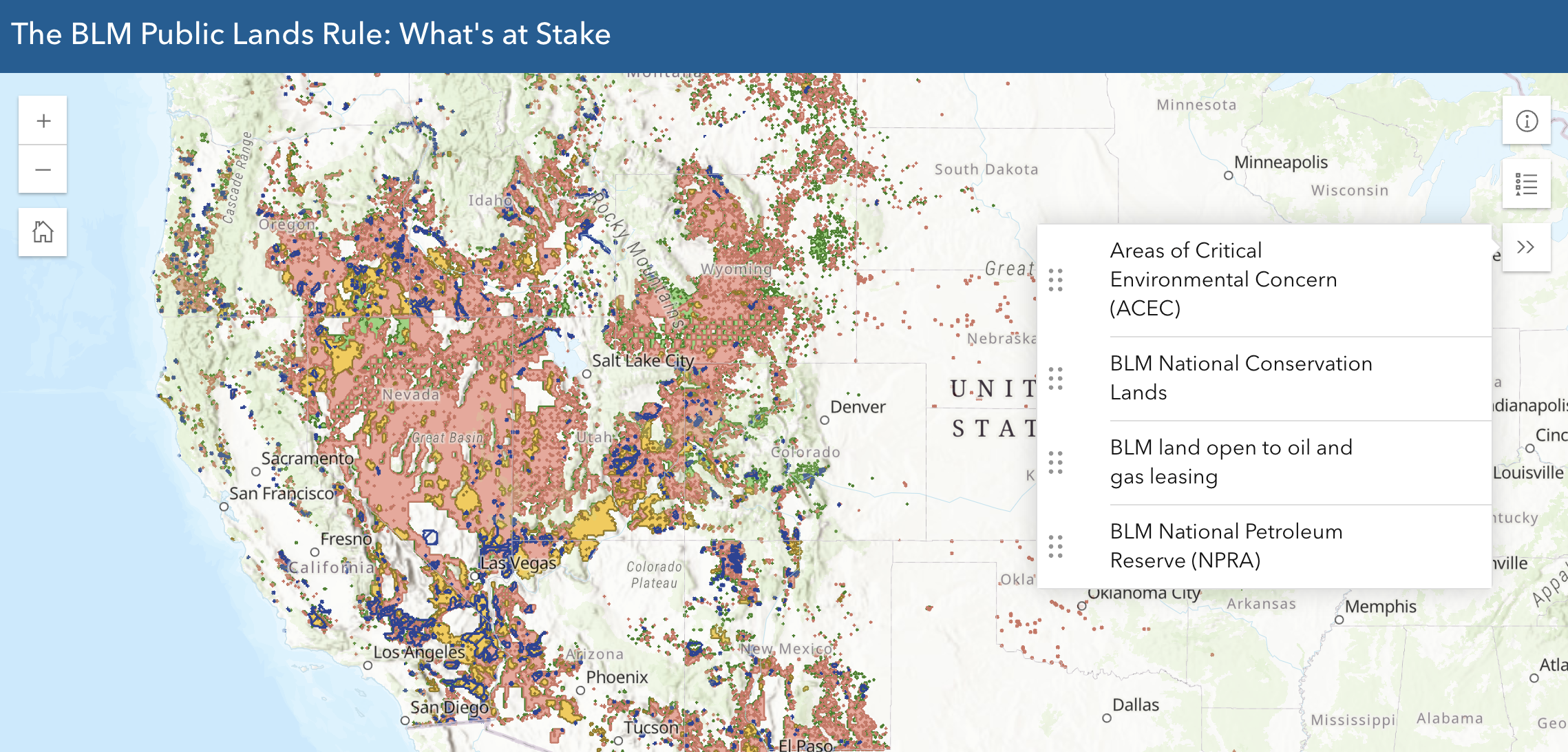
See our map: What’s at stake with the repeal of the BLM Public Lands Rule
▶ What is (and what was) the BLM?
The BLM was created in 1946 by merging the U.S. Grazing Service and General Land Office. The new agency was responsible for the Department of the Interior’s “multiple-use federally owned lands” but lacked a clear mandate or identity. Delegating work among seven regional offices, the early BLM was largely organized around the needs of livestock interests. Though the agency’s attention to conserving natural resources waxed and waned over the following few decades, the throughline and dominant thinking remained that BLM lands were primarily a piggybank for extractive resources.
▶ How did the BLM get its modern “multiple use” mission?
In 1972, a major legal decision over BLM’s grazing program brought the agency under further public scrutiny and helped prompt deeper consideration of uses like conservation and outdoor recreation. The Federal Land Policy and Management Act, passed in 1976, brought that more balanced approach to the fore, constituting an “organic act” similar to the one that launched the National Park Service and specified its mission. From that point, BLM was supposed to dedicate itself to the long-term management of the land for multiple uses in a way that ensures a sustained yield of natural resources for present and future generations. In other words, Congress directed BLM to achieve what the Supreme Court has described as the "the enormously complicated task of striking a balance among the many competing uses to which land can be put.”
▶ Why was the BLM Public Lands Rule needed?
In the years that followed the passage of FLPMA, factors including the Reagan administration’s heavy emphasis on exploiting energy resources helped prevent the BLM from fully executing its balanced multiple-use mission. The law was now clear about what the BLM’s goals should be, but the agency lacked the direction to pursue them (for example: The BLM lacked clear regulatory criteria for which places should be designated as “Area of Critical Environmental Concern,” the sole use that Congress required BLM “prioritize” to protect lands with great natural or cultural value). This resulted in a public lands regime that was (still) overwhelmingly devoted to extractive pursuits over conservation or other uses: A recent report from The Wilderness Society found that as of 2024, 81% of BLM-managed lands were open to oil and gas leasing.
▶ Did the BLM Public Lands Rule balance the scales—and will the rollback upset that balance?
In 2024, the BLM Public Lands Rule culminated a nearly half-century-long search for balance and promised to move the agency away from blatantly catering to drilling, mining, logging and grazing. But there was scarcely time to implement that long-overdue arrangement before the second Trump administration swept into DC and began gutting the Department of the Interior. Almost immediately upon his swearing-in, Interior Secretary Burgum signed a secretarial order calling on staff to review and work toward rescinding the Public Lands Rule, among other barriers to “energy dominance.” Just like that, the guidelines for following FLPMA’s multiple use mandate, which the BLM had spent years creating with ample public input, were on shaky ground. The administration was poised to tilt the scales back in favor of extraction permanently. In the last year, appropriators in Congress took a swing at it too, pushing a spending bill that would block any implementation of the Public Lands Rule.
But the fight isn’t over. As Alison Flint, senior legal director at The Wilderness Society, pointed out when the administration announced its proposed rule rescission, the administration’s rationale is shaky. By ignoring FLPMA and case-law that interprets it, they’re virtually guaranteeing more liability for the already resource-strapped agency into the future.


