
Map: 62% of national forests within ½ mile of backcountry roads

Backcountry forest road
Gaby Diaz
With a staggering amount of routes already open to motorized users, the administration wants to open even more land to off-road vehicles
WASHINGTON, D.C. (October 20, 2026) – A new map created by The Wilderness Society illustrates how much national forest land is within ½ mile of a road or other route intended for motor vehicles.
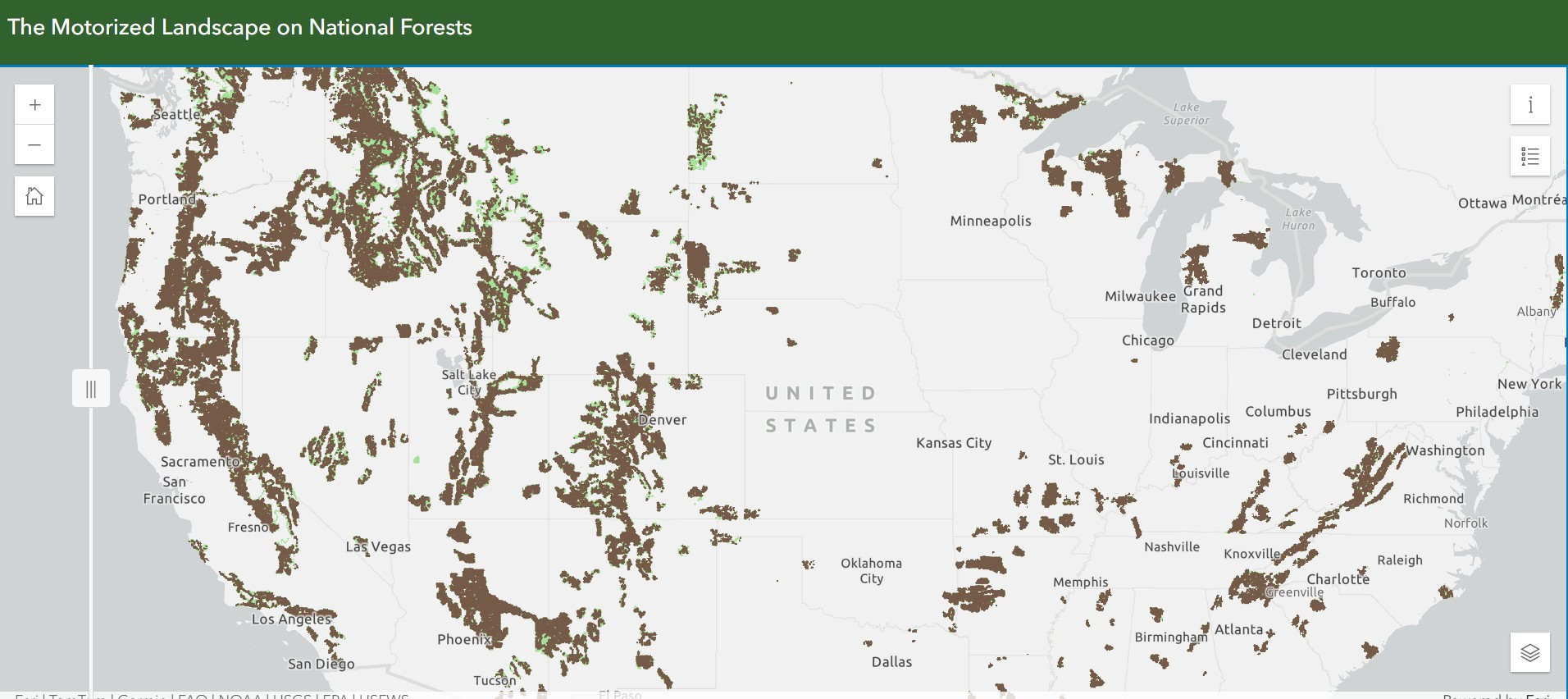
The Forest Service manages 310,860 miles of public, mapped roads and motorized trail routes* across the country’s 150+ million acres** of national forest lands. That’s enough road to drive to the moon and a quarter of the way back.
Despite the staggering mileage already open to off-road vehicles (ORVs), motorcycles, side by sides, four-wheel-drives and snowmobiles, the administration is proposing to open even more areas to engines by revising the agency’s Travel Management Rule. The revision would flip the current “closed unless designated open” system on its head so all routes, including trails, would be open to motorized use unless marked as closed. As a result, horseback riders, hikers, cyclists, hunters and off-roaders would be forced to play tug-of-war over the same trails, increasing the chances of conflict and accidents.
Paul Sanford, director for equitable access policy advocacy at The Wilderness Society, remarked:
"The beauty of our shared public lands is that there's enough room for everyone, and this map shows just how much of our national forests are open to motorized vehicles. Thoughtful travel planning and mapping protect the freedom to recreate responsibly while giving wildlife the space to thrive, ensuring future generations can enjoy these same opportunities. Reversing the clarity that travel management provides is irresponsible and dangerous for everyone."
Top five states with the most motorized roads and trails
State: roads and motorized trail miles, % USFS land outside of wilderness and within ½ mile of motorized route
Oregon: 50,232 miles of motorized trails, 86% of national forests within ½ mile of motorized route
California: 44,105 miles of motorized trails, 76% of national forests within ½ mile of motorized route
Idaho: 27,926 miles of motorized trails, 59% of national forests within ½ mile of motorized route
Arizona: 20,306 miles of motorized trails, 73% of national forests within ½ mile of motorized route
Washington: 16,073 miles of motorized trails, 68% of national forests within ½ mile of motorized route
All national forest lands, excluding wilderness: 310,860 total miles of motorized trails, 62% of national forests within ½ mile of a motorized trail
More engines on non-motorized routes mean more noise that may hurt wildlife
The Forest Service's research found that human-generated noise, including from riding ORVs, can drive mammals away from habitat and affect mating and other behavior. In Wyoming’s Bridger-Teton National Forest, elk were significantly more likely to flee noisy areas than quiet ones. Opening more routes to loud engines will harm wildlife, which will in turn limit opportunities for outdoor recreation and subsistence hunting.
More engines on non-motorized routes mean higher risk of fires
If the Travel Management Rule is revised to allow ORVs on previously closed routes, the risk of human-caused wildlife increases. Research from The Wilderness Society found wildfires are four times more likely to start near roads than in roadless forests, which hold some of the country’s most intact and healthy forest ecosystems. Washington, Oregon and California–the entirety of the West Coast–are at heightened wildfire risk, based on the high proportion of their national forests that are near roadways.
Revising the Travel Management Rule puts even more pressure on our shared national forests, and a strained agency
Combined with the administration’s proposal to repeal the Roadless Rule in its entirety, which would make road-building and commercial development in national forests easier, the travel management changes would effectively open millions of acres of public lands to unchecked motorized vehicle use. These massive proposals come as the Forest Service grapples with a 16% reduction in its workforce, threat of an agency-wide reorganization and significant budget cuts.
These pressures by the administration are systematically dismantling our shared national forests and stripping the agency of the tools and capacity needed to manage these lands effectively, creating dangerous and risky situations for everyone involved. If the Travel Management Rule is erased, future generations will bear the brunt of the impacts.
* The Forest Service defines road and motorized trails as trails open to vehicles 50 inches or less in width (ATV, motorcycle, etc.); trails open to all (full size) vehicles (trails may be rugged and narrow - intended for 4x4s); trails open to motorcycles only (single track).
** Acreage number excludes the roughly 37 million acres of designated wilderness on USFS lands, where roads and motorized vehicles are not permitted.


